:::: MENU ::::

Angular Mechanics


Angular mechanics is a branch of mechanics. Angular mechanics involves the study of motion of a body in a rotational or a circular way. The angular momentum and torque are the most important and responsible part for angular mechanics. When the force is applied to a body that causes it to rotate then it creates torque. Similar to force, torque also acts to angularly accelerate a spinning object. The equation for torque (expressed as Γ here) looks very much like force in a linear motion (F = ma) because the torque is analogous to the force in rotational motion.
Γ = Iα
Instead of mass, we have rotational inertia(mass and inertia are analogous to each other). Instead of linear acceleration, we have angular acceleration(linear acceleration and angular acceleration are analogous to each other).

Now, if a force is applied linearly to make an object move, its torque is defined as:
Γ  = F × r
In angular mechanics, angular momentum, moment of momentum, or rotational momentum is a quantity in a rotational motion is analogous to linear momentum in translation motion. Just as linear momentum is equal o the product of mass and linear velocity, angular momentum is equal to the product of M.I. and angular velocity. It is also a vector quantity.
L = r × p = r × mv,
L =Iw
Where,
r- radius of vector,
P-linear momentum,
m- mass of the body,
v- velocity of a body,
I-moment of inertia,
w-angular velocity
Where there is no net external torque, angular momentum is conserved in a system and its conservation helps explain many diverse phenomena. Let us see one example- the increase in rotational speed of a spinning figure skater as the skater's arms are contracted is a consequence of conservation of angular momentum. The another example is-a very high rotational rates neutron stars. It means, angular momentum conservation has numerous applications in physics and engineering.


Gravity


An object released from some high above the surface of the earth falls freely with an acceleration. This accelerate motion is due to the force of attraction exerted by the earth on the object. The motion of the moon in a circular orbit around the earth also shows that the earth exerts a force of attraction between the sun and suggest the existence of a force of attraction between the sun and the plant. These observations led Newton  to the conclusion that any two material objects always attract each other. This attraction is called gravity or gravitation and the force of attraction is called the gravitational force.
Newton’s law of gravity or gravitation:
The gravitational force between any two material object is given by Newton’s law of gravitation, which is every particle of matter attraction every other particle of matter with a force which is directly proportional to the product of their masses and inversely proportional to the square of distance between them.
Suppose two particles of masses m1 to m2 separated by a distance r them according to Newton’s law of gravitation, these particles attract each other with a force whose magnitude (F) is given by
F::m1m2 / r2
f = Newton’s law of gravity
where  G is a constant called constant of gravity.
SI unit of GI is Nm2/kg2 its dimensions can be determined
[G] = Newton’s law of gravity
= Newton’s law of    gravity
=  [M -1L3 T-2]
The gravitational force between two particles act along the line joining the two particles and they form an action reaction pair. The force exerted by the first particle on the second particle is exactly equal and opposite to the force exerted by the second particle on the first.
Newton’s law of gravitation holds good for all material object irrespective of their sizes or distance between them. Therefore it is called a universal law and the constant of gravity G1 is called the universal constant its value is 6.673 x 10⁻¹¹ Nm2/kg2. In order to explain how to masses attract each other even though there is no physical contact between them, the concept of gravitational field is introduced. According to this concept, there exists a gravitational field in the space surrounding and mass. When another mass is brought into this space, it is acted upon by the gravitational force of attraction.

Motion


Change in the position of an object with respect to time is the motion of an object is the motion of an object. Motion is one of the most important part of branch of physics called mechanics. Everybody on the Earth moves. The movement might be slow or very very slow. If we are standing on earth then earth moves around the Sun and Sun moves around the galaxy. It means that the movement of a body never stops.
To have a motion of an object or to change its motion, the force should be acted on an object. When some Physicists observe that, how an object moves? , they use some basic terms like the speed or velocity with which an object moves, the mass of an object which also affects on motion of object, forces acting on an object, acceleration(rate of change of velocity with respect to time), energy and the work.
Some basic equations related to motion:
v(velocity) = s(displacement)/ t(time)
a(accelaration) = dv(changes in velocity) / dt(changes in time)
F(force) = ma where, m=mass
Types of Motion:
  • Uniform motion In this type of motion the direction and the speed of an object are the same and do not change with respect to time. In such case, the object moves in the same direction and travels through equal distance in equal interval of time, however these intervals may be small.  Obviously, when the object is in uniform motion, its instantaneous velocity (it is average velocity as the time-interval t becomes extremely small) is the same everywhere along its path. Also its average velocity is the same as its instantaneous velocity.
  • Variable motion In this type of motion the direction or speed changes with respect to time. In this displacement of an object varies from instant to instant, either increasing or decreasing.
  • Periodic motion
    The motion that repeats and always returns to its original initial position is called periodic motion. Periodic motion repeats in equal interval of time. Examples of periodic motion are a rocking chair, a bouncing ball, a vibrating guitar string, a swinging pendulum, and a water wave, the motion of the Earth in its orbit around the sun.

Law Of Motion


There are three laws of motion and they were first compiled by Sir Isaac Newton in his work Philosophiæ Naturalis Principia Mathematica, first published on July 5, 1687. Newton used these laws to explain and investigate the motion of many physical objects and systems. Newton showed that these laws of motion when combined with his law of universal gravitation, explained Kepler's laws of planetary motion.
Newton's laws are applied only to bodies (objects) which are considered or idealized as a particle, in the sense that the extent of the body is neglected in the evaluation of its motion, i.e.,the object is small when compared to the distances involved in the analysis, or the deformation and rotation of the body is of no importance in the analysis. Therefore, a planet is idealized as a particle for analysis of its orbital motion around a star.
Laws of motion are described as follows:
  • First law: Every body remains in its state of rest or uniform motion (constant   velocity) unless it is compelled by an external unbalanced force to change that state. It means that in the absence of a non-zero or the net force the center of a mass of a body either remains at rest, or moves at a constant speed in a straight line.
  • Second law: The rate of momentum of a body is directly proportional to the impressed force and takes place in the direction of the force. It means a body of mass m subject to a force F undergoes an acceleration a that has the same direction as the force and a magnitude that is directly proportional to the force and inversely proportional to the mass, i.e., F= ma. Alternatively, the total force applied on a body is same to that of the time derivative of the linear momentum of the body.
  • Third law: To every action, there is equal and opposite reaction or the mutual forces of action and reaction between two bodies are equal, opposite and collinear. It means that whenever a first body exerts a force F on a second body, the second body exerts a force   -F on the first body. F and -F are equal in magnitude and opposite in direction. This law is usually referred to as action-reaction law with F called the "action" and -F the "reaction".

Banking of a Road Surface

Mechanics
Banking of a Road Surface

Moving in a Straight line on a Horizontal Surface
Turning on a Horizontal Surface
The normal reaction, R, has no component acting towards the centre of the circular path.
Therefore the required centripetal acceleration is provided by the force of friction, Ff, between the wheel and the road.
If the force of friction is not strong enough, the vehicle will skid.
Turning on a Banked Surface
The normal reaction, R, now has a component acting towards the centre of the circular path.
If the angle, OMEGABSM, is just right, the correct centripetal acceleration can be provided by the horizontal component of the normal reaction.
This means that, even if there is very little force of friction the vehicle can still go round the curve with no tendency to skid.
Angle of Banking
The magnitude of the horizontal component of the normal reaction is
FORMULA36 
This force causes the centripetal acceleration, so, the magnitude of RH is also given by
equation 1
 So,
FORMULA38
equation 2
The vertical forces acting on the vehicle are in equilibrium.
Therefore, considering magnitudes only
FORMULA34 
Dividing equation 1 by equation 2 gives:
FORMULA35
This equation allows us to calculate the angle OMEGABSM needed for a vehicle to go round the curve at a given speed, v, without any tendency to skid.

How Dry Cell Batteries Generate Electricity


written by: Aggeliki K. • edited by: Lamar Stonecypher • updated: 5/20/2011
Normally a dry cell is also referred to as a Zinc-Carbon Leclanche cell. It is an easily portable, compact, and modified form of Leclanche cell capable of producing an EMF of 1.5 V with a very small internal resistance in the order of 0.1 ohm.
  • Dry Cell History and Advances

    The first dry cell was invented in the late 19th century. It used zinc as an anode, manganese dioxide as an “earthode,” and a gelled, moist mixture of ammonium chloride and zinc chloride as electrolyte.
    Later they created a dry cell made up of carbon as a cathode, zinc as an anode, and sal-ammoniac paste as an electrolyte. This type of dry cell is commonly known as a carbon zinc Leclanche cell. Even today, most of the dry cells manufactured are of this kind due to its lower manufacturing cost and its being suitable for all applications requiring intermittent current, such as used in flashlights and transistor receivers.
    These cells have a few drawbacks such as their low energy density and limited lifetime. In later years, a large number of new types of dry cells were developed for new and different applications.
    Modification in Leclanche Cell to become a Dry Cell
    The glass in Leclanche cell is replaced by a zinc container, and the ammonium chloride solution is replaced by a moist sal-ammoniac paste.
    The Dry Cell is a Primary Cell
    Prev Year Paper,Answers,Solutions by Top IITians, See JEE Analysis
    The cells from which electric energy is derived by irreversible chemical action are called primary cells. The primary cell is capable of providing an EMF when its constituent’s two electrodes and a suitable electrolyte are assembled together. The three main primary cells namely are the Daniel cell, the Leclanche cell, and the dry cell. None of these cells can be recharged electrically.
  • Commercial Dry Cells

    Commercial Dry CellsCommercial Dry Cells (2)
  • How Chemical Energy is converted into Electrical Energy in Cells

    Chemical effect of current
    Conversion of electric energy into chemical energy: the passage of an electric current through a liquid causes chemical changes through a process called electrolysis. Conduction is possible only in liquids wherein charged ions can be dissociated in opposite directions. Such liquids are called electrolytes, and the plates through which current enters and leaves an electrolyte are known as electrodes. The electrode towards which positive ions travel is called the cathode, and the electrode towards which negative ions travel is called the anode. The positive ions are called cations and negative ions are called anions.
    Effect of Chemicals in Batteries
    Conversion of chemical energy into electrical energy: in this case, the reverse process takes place due to the chemical reaction between two electrodes in the presence of an electrolyte and an electric current is produced.
    Faraday’s Laws of Electrolysis
    First law:
    The mass of a substance liberated at an electrode is directly proportional to the charge passing through the electrode.
    Second law:
    The mass of a substance liberated at an electrode by a given amount of charges is proportional to the chemical equivalent of the substance.
  • Working of a Dry Cell:

    Parts:
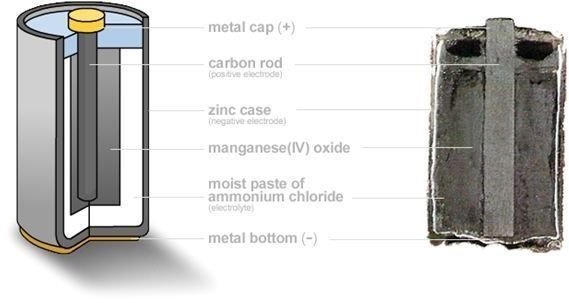
    Anode (Negative Terminal): Zinc
    Cathode (Positive Terminal): Carbon coated with MnO2
    Electrolyte: Mixture of plaster of Paris, Ammonium Chloride and Zinc Chloride
    Dry cells contain a Zinc container which itself acts as a negative electrode. The moist paste is made from a mixture of plaster of Paris, Ammonium Chloride, and Zinc Chloride called sal ammoniac paste. This forms the electrolyte of the cell and takes up the major amount of volume in the battery. Zinc Chloride is hygroscopic in nature and helps to maintain the moistness of the paste. It is wrapped in a canvas sheet.
    • Anode reaction: The oxidization of Zinc gives two electrons.
    Zn(solid) → Zn2 + (aqueous) + 2 (e-)
    The carbon rod forms the positive electrode. It is coated with MnO2 and powdered carbon. The powdered carbon reduces the internal resistance of the cell. The top of the cell contains a layer of sawdust. This acts as the base for the top layer of bitumen used for sealing purposes.
    • Cathode reaction:
    2MnO2(solid) + H2(gas)→ Mn2O3(solid) + H2O(liquid)
    • Electrolyte reaction: Hydrogen from Ammonium chloride
    2NH4 + (aqueous ) + 2 (e-) → H2(g) + 2NH3(aqueous)
    • Overall reaction in dry cell:
    Zn(s) + 2MnO2(s) + 2NH4(+)(aqueous) → Mn2O3(solid) + Zn(NH3)2 (2+)(aqueous) + H2O(liquid)


    A vent is provided in this layer to allow the gases formed in the chemical reaction to escape. Irrespective of the size of the dry cell, the EMF is 1.5 V because the zinc and carbon rods used as electrodes specified a chemical equivalent. The chemical equivalent changes from metal to metal and, depending on the type of combination used, the EMF differs.
  • Dry Cell Parts

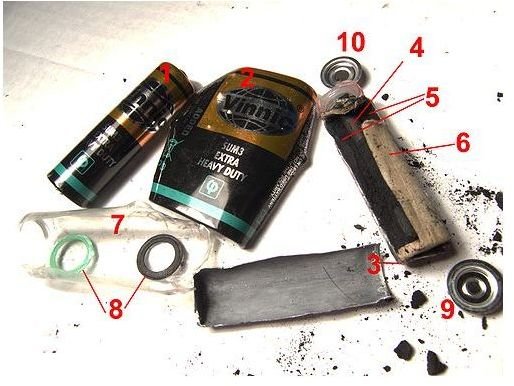
    Dry cell partsDry cell Disassembled

Daniell Cell


Daniell cell is also known as Galvanic cell which using same working principle as voltaic cell. It converts chemical energy to electrical energy. Daniell cell is a part of a battery consisting of two metals joined by a salt bridge or a porous pot.


  • More electropositive metal acts as negative terminal which undergoes oxidation process (release electron)
  • Less electropositive metal acts as positive terminal which undergoes reduction (gain electron).
  • Electron flow from negative terminal to positive terminal.
  • The function of salt bridge or porous pot is to allow the movement of ions to pass through it to complete electrical circuit. Another function is to separate two electrolyte solutions. 
  • Examples of salt bridge are sodium chloride or potassium nitrate.


At Negative Terminal: More electropositive metal ( Zinc )

Observation:  Zinc plate dissolves or becomes thinner, its mass decreases
                        
Half chemical equation :     Zn  ------>     Zn2+   +    2e

At Positive Terminal: Less electropositive metal ( Copper )
                                               
Observation:  Copper plate becomes thicker
                        
Half chemical equation :     Cu2+     +    2e   ------>    Cu


डॉक्टर रॉबर्ट हर्शहॉर्न
चीनी, नमक और पानी का घोल. किचन से वास्ता रखने वालों को ये नुस्खा तो शायद कई सौ साल पहले से ही पता होगा, लेकिन इस घोल में किस अनुपात में क्या हो, यह बताने में डॉक्टर नॉर्बर्ट हिर्सहॉर्न की अहम भूमिका रही. डॉक्टर नॉर्बर्ट के इस नुस्खे ने लगभग पाँच करोड़ ज़िंदगियाँ बचाई हैं.
मिस्र में एक तीन महीने का बच्चा दो दिन से डायरिया का शिकार है इस कदर कमज़ोर हो गया है कि वह दूध पीने के लिए मां के स्तन पर अपना सिर तक नहीं टिका पाता. अलेक्सांद्र के उपचार केंद्र में जब इस बच्चे को लाया गया तो एकबारगी डॉक्टर भी घबरा गए थे.
लेकिन उपचार के चार घंटे बाद ही वह मां का दूध पीने लगा और यह सब संभव हुआ चीनी, नमक और पानी के घोल से.
डॉक्टर नॉर्बर्ट का कहना है कि ओरल रिहाइड्रेशन थेरेपी के परिणाम अविश्वसनीय रहे हैं.

संतुलन की प्यास

डॉक्टर नॉर्बर्ट 1964 से ओरल रिहाइड्रेशन थेरेपी से जुड़े. वह अमरीका की सैन्य स्वास्थ्य सेवा में थे.
बांग्लादेश (तब पूर्वी पाकिस्तान) में हैजा गंभीर रूप ले चुका था. ऐसे वक़्त डॉक्टर नॉर्बर्ट को वहाँ भेजा गया. हैजा होने से मरीज के शरीर में पानी की भारी कमी हो जाती है और वह कुछ ही घंटों में दम तोड़ सकता है.
मिस्र में महिलाएं अपने बच्चों को नमक-चीनी का घोल पिलाते हुए
पूर्वी पाकिस्तान के लगभग 40 प्रतिशत गांवों में लोग हैज़े का इलाज न होने से मर रहे थे.
तब रिहाइड्रेशन का उपचार अस्पताल में नस के माध्यम से होता था. यह महंगा था और उनको नहीं मिल पाता था जिन्हें इसकी सबसे ज़्यादा ज़रूरत होती थी.

असाधारण नतीजे

इसलिए मुंह के रास्ते दिए जाने वाले उपचार पाने की कोशिशें की गई ताकि अधिक से अधिक लोगों की मदद की जा सके.
नमक, चीनी और पानी के सही अनुपात पर कई प्रयोग पहले भी हो चुके थे, लेकिन ये नाकामयाब रहे थे और कई मरीजों की मौत हुई थी.
डायरिया से पीड़ित इस व्यक्ति को एक हफ्ते में 100 से अधिक ग्लूगोज की बोतलें चढ़ानीं पड़ीं
डॉक्टर नॉर्बर्ट कहते हैं, "ताइवान और फिलीपींस में नौसेना के साथ तैनाती के दौरान भी मैंने सही नुस्खा बनाने की कोशिश की, लेकिन यह कुछ ज़्यादा ही गाढ़ा बन गया और चीज़ें और ख़राब हो गईं."
डॉक्टर नॉर्बर्ट ने बताया, "इस नुस्खे का आसान होना की इसका दुश्मन था. शिशुरोग विशेषज्ञों को यह समझाने में लंबा समय लग गया कि यह सुरक्षित है."
ब्रिटेन की स्वास्थ्य पत्रिका लांसेट और यूनिसेफ़ ने इसे स्वास्थ्य क्षेत्र में बीसवीं सदी की सबसे उम्दा खोज बताया है, जिसने बेहद सस्ती होने के बावजूद हर साल लाखों जीवन बचाई है.

How does a fluorescent starter work?


A fluorescent light does not have the usual glowing filament of an incandescent bulb, but instead contains a mercury vapor that gives off ultraviolet light when ionized. The ultraviolet light makes particles that coat the inside of the tube, and these particles glow or fluoresce (see How Fluorescent Lamps Work for details).
Fluorescent starters are used in several types of fluorescent lights. The starter is there to help the lamp light. When voltage is applied to the fluorescent lamp, here's what happens:
  1. The starter (which is simply a timed switch) allows current to flow through the filaments at the ends of the tube.
  2. The current causes the starter's contacts to heat up and open, thus interrupting the flow of current. The tube lights.
  3. Since the lighted fluorescent tube has a low resistance, the ballast now serves as a current limiter.
When you turn on a fluorescent tube, the starter is a closed switch. The filaments at the ends of the tube are heated by electricity, and they create a cloud of electrons inside the tube. The fluorescent starter is a time-delay switch that opens after a second or two. When it opens, the voltage across the tube allows a stream of electrons to flow across the tube and ionize the mercury vapor.
Without the starter, a steady stream of electrons is never created between the two filaments, and the lamp flickers. Without the ballast, the arc is a short circuit between the filaments, and this short circuit contains a lot of current. The current either vaporizes the filaments or causes the bulb to explode.
According to Sam's F-Lamp FAQ:
The most common fluorescent starter is called a "glow tube starter" (or just starter) and contains a small gas (neon, etc.) filled tube and an optional radio frequency interference (RFI) suppression capacitor in a cylindrical aluminum can with a 2 pin base. While all starters are physically interchangeable, the wattage rating of the starter should be matched to the wattage rating of the fluorescent tubes for reliable operation and long life.
The glow tube incorporates a switch which is normally open. When power is applied, a glow discharge takes place which heats a bimetal contact. A second or so later, the contacts close and provide current to the fluorescent filaments. Since the glow is extinguished, there is no longer any heating of the bimetal and the contacts open. The inductive kick generated at the instant of opening triggers the main discharge in the fluorescent tube. If the contacts open at a bad time, there isn't enough inductive kick and the process repeats.

Absurd Creature of the Week: This Goofy Fish Poops Out White-Sand Beaches


jj
The parrotfish may or may not feed exclusively on algae. Probably does though. John Johnson
Ah, Hawaii. The resplendent luaus and awe-inspiring volcanoes. Tom Selleck and his mustache running around private-investigating stuff. The beautiful white-sand beaches made of fish poop.
Oh, that’s right. Your precious Hawaiian beach vacation was actually a frolic through epic amounts of doody. Specifically, the doody from a very special kind of critter: the parrotfish. You see, parrotfish are quite partial to the algae that grow on coral, and they gnaw it off with two impressive rows of fused, beak-like teeth (hence their name). Simply by chewing on reefs, a large Hawaiian parrotfish can ingest a coral’s calcium carbonate and poop out up to 800 pounds of sand each year, according to marine biologist Ling Ong of Hawaii’s SWCA Environmental Consultants. One Australian species, she notes, produces up to one ton per year.
And the parrotfish isn’t alone here. “In places like Hawaii, where we have very little terrestrial input of sand, almost all of our sand is of biological origin,” Ong said. “So I like to tell people that the sand you’re standing on in Hawaii has probably gone through the gut of something. It’ll have gone through the gut of a parrotfish, a sea urchin, some kind of worm.”
cao
Parrotfish come in staggeringly beautiful colors, unless you’re color blind. In which case, you’ll have to just take my word for it. John Johnson
Parrotfish, though, serve a far more important purpose in their grazing. Algae is a major threat to corals, positively smothering them and stealing their precious light. Parrotfish play a huge role in keeping algae in check, though they can get a bit carried away. Some species have evolved to not only skim the algae off the top, but gnaw a few millimeters down to reach algae that has penetrated the coral. Overall, though, they’re the reef’s benevolent and indispensable gardeners.
Now, if you’re anything like me, you considered eating chalk at some point in your childhood. Luckily I never did—which isn’t to say I didn’t come close—because blackboard chalk used to be made of calcium carbonate, exactly what coral is made of. And when calcium carbonate mixes with acid, it fizzes like crazy. “It creates carbon dioxide,” said Ong. “So if you’re a regular animal and you had acid in your stomach and you ate a chunk of chalk, you would get fizzy quickly. It would be generating a lot of gas.”
So why aren’t parrotfish spontaneously exploding all over the reef? Well, they don’t have stomachs. They simply gnaw off the algae and calcium carbonate and grind it up with teeth at the back of their throat known as pharyngeal jaws (the same jaws, by the way, that the moray eel has evolved into horrifying forward-thrusting chompers like those in the queen from Alien). Their digestive systems then take up the nutritious algae while firing out the calcium carbonate as sand.

Mucus Sleeping Bags and Polychromatic Sex Changes

All of this beach-building is exhausting work, and indeed the parrotfish is a strangely heavy sleeper. Like, dangerously heavy. “They don’t wake up easily at all, which makes them fairly easy to catch,” said Ong, “because you can go down and shine a light at them and they’ll be sound asleep. And the ones you do catch, you put them in a dark bag and they go back to sleep.”
Ong isn’t sure why exactly they need such deep sleep, though it wouldn’t seem to make much evolutionary sense. Why leave yourself so vulnerable?
Well, younger, smaller parrotfish, which are of course more susceptible to predation, have a brilliant little trick. They tuck themselves into a crevice or under a ledge and secrete mucus to build a translucent, semi-solid sleeping bag, which balloons to encase the parrotfish in a water-filled bubble. It’s likely a measure to mask their scent from predators, or a kind of proximity sensor to detect when something is closing in. And when they wake up in the morning, they’ll recycle the cocoon by eating it for breakfast. Try doing that with your sleeping bag the next time you go camping.
jj
A parrotfish demonstrates the world’s most ineffective force field. John Johnson
But their heavy sleep makes the larger individuals extremely vulnerable to spearfishers, who target the easy prey at night. And while losing an individual parrotfish every once in a while to fishing may not seem like a huge deal, the way parrotfish societies are set up makes this kind of hunting a serious threat.
You see, most parrotfish species are sex-changers. Individuals are born female and form into schools. Once they’ve matured, the largest female will change into a male, assuming rule over the school, which essentially becomes his harem. He begins managing territory, chasing away rival males, and transforms his drab skin into the gaudy colors in the photos above.
Yet this color shift doesn’t happen every time. Some males eschew the lovely new outfit in favor of a more sneaky strategy: They pretend to still be female. “So when it comes to spawning, they can sneak in,” said Ong. “When the males and females spawn—either in the territory, or some of them actually congregate in a place and they group-spawn—the sneaker males can insert themselves in there. And there are a fair number, so it’s a reproductive strategy that must work.” (The giant Australian cuttlefish actually does the same, with males manipulating their arms to look like females, sneaking under dominant males to steal a kiss with their mates, and by steal a kiss I mean hand her bundles of sperm.)
cap
If you’re going to sleep like a rock, you may as well look like one too. John Johnson
Now, it’s great being the big man on campus—until a bigger bully shows up. “This is a fish that a lot of Pacific Islanders like to eat,” said Ong. “And normally they target the biggest fish, and that causes a problem for these kinds of sex changes, because you’re taking a lot of the males out of the population. And you’re also taking a lot of the big females out of the population, and they’re the ones that are creating the most young.”
Indeed, the creatures are overfished in most parts of the world, setting off a domino effect that leaves coral, already struggling to survive climate change, at the mercy of algae. And interestingly, according to Ong, parrotfish seem to be getting smaller. Could we be artificially selecting against the largest individuals by removing them from the gene pool? After all, we seem to have done the same with elephant tusks, poaching individuals with the most ivory and keeping them from passing along their genes for such size.
Really, it’s no way to treat such a wonderfully bizarre fish, much less a creature that’s building our beaches free of charge. So the next time you’re lounging in the sands of Hawaii, take a moment to appreciate the parrotfish, which only ever wanted to gnaw on coral and sleep in its own snot, and maybe, if it’s lucky, undergo a sex change. And if that’s not one hell of an iconoclastic life, I don’t know what is.

(got on bbc)