1.) If we line up the entire blood vessel in human body, the length
will be approximately 62,000 miles! Which means it’s about 2.5 times
longer than circumference of planet earth.
2.) ‘The Great Barrier Reef’, world’s longest coral reef located in
Australia. Also owns the record of world’s largest organism structure
with the length of 2000 kilometer.
3.) Probability that earth will be attacked by meteors: 9300 times/year.
4.) One giant hurricane generates energy at the same level of 8000 1-megaton sized bombs.
5.) Approximately, 700 millions of world population is now having hookworm, kind of blood-eating creature, in their bodies.
6.) Fred Rompelberg owns the record of world’s fastest cycler with the speed of 166.94 miles/hour.
7.) 65% of autistics patient are lefty.
8.) The roots of Finnish pine tree can be so long up to 30 miles.
9.) The amount of salt in the ocean can cover ever area on earth with 500 feet thick.
10.) The gas among the stars in Sagittarius contains more than 10,000 millions liter of alcoholic substances.
11.) The speed of Polar bear is up to 25 miles/hour and they can jump up to 6 feet high.
12.) Because of the qualification of its hair, Polar bear is very difficult to detect with infrared camera.
13.) The roots of rye, types of rice used in drinking alcohol
production, can be spread under the ground for more than 400 miles.
14.) Temperature of Mercury is 430c during daytime and decrease down to -180c during night time.
15.) Approximately, people will unintentionally eat up to 4300 small type of bugs, such as gnat and tick, in a year.
The Cold Spot area resides in the constellation Eridanus in the
southern galactic hemisphere. The insets show the environment of this
anomalous patch of the sky as mapped by Szapudi's team using PS1 and
WISE data and as observed in the cosmic
In 2004, astronomers examining a map of the radiation leftover
from the Big Bang (the cosmic microwave background, or CMB) discovered
the Cold Spot, a larger-than-expected unusually cold area of the sky.
The physics surrounding the Big Bang theory predicts warmer and cooler
spots of various sizes in the infant universe, but a spot this large and
this cold was unexpected.
Now, a team of astronomers led by Dr. Istvan Szapudi of the
Institute for Astronomy at the University of Hawaii at Manoa may have
found an explanation for the existence of the Cold Spot, which Szapudi
says may be "the largest individual structure ever identified by
humanity."
If the Cold Spot originated from the Big Bang itself, it could be a
rare sign of exotic physics that the standard cosmology (basically, the
Big Bang theory and related physics) does not explain. If, however, it
is caused by a foreground structure between us and the CMB, it would be a
sign that there is an extremely rare large-scale structure in the mass
distribution of the universe.
Using data from Hawaii's Pan-STARRS1 (PS1) telescope located on
Haleakala, Maui, and NASA's Wide Field Survey Explorer (WISE) satellite,
Szapudi's team discovered a large supervoid, a vast region 1.8 billion
light-years across, in which the density of galaxies is much lower than
usual in the known universe. This void was found by combining
observations taken by PS1 at optical wavelengths with observations taken
by WISE at infrared wavelengths to estimate the distance to and
position of each galaxy in that part of the sky.
Earlier studies, also done in Hawaii, observed a much smaller area in
the direction of the Cold Spot, but they could establish only that no
very distant structure is in that part of the sky. Paradoxically,
identifying nearby large structures is harder than finding distant ones,
since we must map larger portions of the sky to see the closer
structures. The large three-dimensional sky maps created from PS1 and
WISE by Dr. András Kovács (Eötvös Loránd University, Budapest, Hungary)
were thus essential for this study. The supervoid is only about 3
billion light-years away from us, a relatively short distance in the
cosmic scheme of things.
Imagine there is a huge void with very little matter between you (the
observer) and the CMB. Now think of the void as a hill. As the light
enters the void, it must climb this hill. If the universe were not
undergoing accelerating expansion, then the void would not evolve
significantly, and light would descend the hill and regain the energy it
lost as it exits the void. But with the accelerating expansion, the
hill is measurably stretched as the light is traveling over it. By the
time the light descends the hill, the hill has gotten flatter than when
the light entered, so the light cannot pick up all the energy it lost
upon entering the void. The light exits the void with less energy, and
therefore at a longer wavelength, which corresponds to a colder
temperature.
Getting through a supervoid can take millions of years, even at the speed of light,
so this measurable effect, known as the Integrated Sachs-Wolfe (ISW)
effect, might provide the first explanation one of the most significant
anomalies found to date in the CMB, first by a NASA satellite called the
Wilkinson Microwave Anisotropy Probe (WMAP), and more recently, by
Planck, a satellite launched by the European Space Agency.
While the existence of the supervoid and its expected effect on the
CMB do not fully explain the Cold Spot, it is very unlikely that the
supervoid and the Cold Spot at the same location are a coincidence. The
team will continue its work using improved data from PS1 and from the
Dark Energy Survey being conducted with a telescope in Chile to study
the Cold Spot and supervoid, as well as another large void located near
the constellation Draco.
The study is being published online on April 20 in Monthly Notices of the Royal Astronomical Society
by the Oxford University Press. In addition to Szapudi and Kovács,
researchers who contributed to this study include UH Manoa alumnus
Benjamin Granett (now at the National Institute for Astrophysics,
Italy), Zsolt Frei (Eötvös Loránd), and Joseph Silk (Johns Hopkins).
from :-
phys.org
App turns a smartphone into a pocket-sized cosmic ray detector
Joe Palca
Smart phones contain a silicon chip inside the camera that
might be used to detect rare, high energy particles from outer space.
J. Yang/Courtesy of WIPAC
Scientists in California are hoping to use your smart phone to
solve a cosmic mystery. They're developing an app to turn your phone
into a cosmic ray detector. If enough people install the app, the
scientists think they'll be able to figure out once and for all what's
producing the very energetic cosmic rays that occasionally hit the
Earth.
The project is the brainchild of physicists Daniel Whiteson at the University of California, Irvine, and his buddy Michael Mulhearn at the University of California, Davis. Both spend time in Switzerland, working on the giant particle accelerator known as the Large Hadron Collider.
Whiteson says the Large Hadron Collider, located in a tunnel beneath
the Swiss-French border near Geneva, is so huge and so complicated that
scientists must share their time on the collider.
"The two of
us each work on these enormous collaborations of about 3,000
scientists," he says. "And while that's very interesting, and you a meet
lot of sharp people, it's also nice sometimes to do a smaller project
where you can be in control of what's happening."
That's where the smart phone comes in. Whiteson and his California pals, as well as new collaborator, Kyle Cranmer at New York University, are building an app
that turns the CMOS chip in the phones camera into a particle detector.
They're hoping millions of people all over the globe will download the app.
When a high energy cosmic ray hits the top of Earth's atmosphere, it creates a shower of new energetic particles.
"So
if we have a bunch of users nearby each other, all running the app,
they will all see hits in their phone, they'll see particles being
detected by our app in their phone in the same moment," says Whiteson.
And
by analyzing the distribution of the particle shower detected by the
phones, Whiteson says, the astrophysicists will learn more about the
high energy cosmic ray that produced the shower.
That's the idea, anyway.
Whiteson
says the reaction from other astrophysicists to his scheme ranges from
bemused to skeptical. But he thinks that's reasonable.
"We
don't yet know if it's the best idea we ever had, or the silliest idea
that we ever had," he says. "But one thing we do know is, it's one of
the funnest to work on."
Could there be a link between galactic cosmic rays and cloud
formation? An experiment at CERN is using the cleanest box in the world
to find out
The Cosmics Leaving Outdoor Droplets
(CLOUD) experiment uses a special cloud chamber to study the possible
link between galactic cosmic rays and cloud formation. Based at the Proton Synchrotron (PS)
at CERN, this is the first time a high-energy physics accelerator has
been used to study atmospheric and climate science. The results should
contribute much to our fundamental understanding of aerosols and clouds,
and their affect on climate.
Cosmic rays are charged particles that bombard the Earth's atmosphere
from outer space. Studies suggest they may influence cloud cover either
through the formation of new aerosols (tiny particles suspended in the
air that can grow to form seeds for cloud droplets) or by directly
affecting clouds themselves. Clouds exert a strong influence on the
Earth’s energy balance; changes of only a few per cent have an important
effect on the climate. However, despite its importance for climate,
aerosol formation is poorly understood. Measuring the underlying
microphysics in controlled laboratory conditions is important for a
better understanding of atmospheric aerosol and is the key to
unravelling the possible connection between cosmic rays and clouds.
The CLOUD experiment involves an interdisciplinary team of scientists
from 17 institutes in nine countries, comprising atmospheric physicists
and chemists, and cosmic-ray and particle physicists. The Proton
Synchrotron provides an artificial source of “cosmic rays” that
simulates natural conditions between ground level and the stratosphere. A
beam of particles is passed through the cloud chamber and its effects
on aerosol production or on liquid or ice clouds inside the chamber are
recorded and analysed.
The experiment includes an advanced cloud chamber equipped with a
wide range of external instrumentation to monitor and analyse its
contents. The temperature conditions anywhere in the atmosphere can be
recreated within the chamber. All experimental conditions can be
controlled and measured, including the “cosmic ray” intensity and the
trace atmospheric vapours in the chamber, which are set to levels of
only a few molecules per trillion.
from http://home.web.cern.ch/about/experiments/cloud
Mysterious radio wave flashes from far outside the galaxy are
proving tough for astronomers to explain. Is it pulsars? A spy
satellite? Or an alien message?
BURSTS of radio waves flashing across the sky seem
to follow a mathematical pattern. If the pattern is real, either some
strange celestial physics is going on, or the bursts are artificial,
produced by human – or alien – technology.
Telescopes have been picking up so-called fast radio bursts
(FRBs) since 2001. They last just a few milliseconds and erupt with
about as much energy as the sun releases in a month. Ten have been
detected so far, most recently in 2014, when the Parkes Telescope in New
South Wales, Australia, caught a burst in action for the first time.
The others were found by sifting through data after the bursts had
arrived at Earth. No one knows what causes them, but the brevity of the
bursts means their source has to be small – hundreds of kilometres
across at most – so they can't be from ordinary stars. And they seem to
come from far outside the galaxy.
The weird part is that they all fit a pattern that doesn't match what we know about cosmic physics.
To calculate how far the bursts have come,
astronomers use a concept called the dispersion measure. Each burst
covers a range of radio frequencies, as if the whole FM band were
playing the same song. But electrons in space scatter and delay the
radiation, so that higher frequency waves make it across space faster
than lower frequency waves. The more space the signal crosses, the
bigger the difference, or dispersion measure, between the arrival time
of high and low frequencies – and the further the signal has travelled.
Michael Hippke of the Institute for Data
Analysis in Neukirchen-Vluyn, Germany, and John Learned at the
University of Hawaii in Manoa found that all 10 bursts' dispersion
measures are multiples of a single number: 187.5 .
This neat line-up, if taken at face value, would imply five sources for
the bursts all at regularly spaced distances from Earth, billions of light-years away.
A more likely explanation, Hippke and Lerned say, is that the FRBs all
come from somewhere much closer to home, from a group of objects within
the Milky Way that naturally emit shorter-frequency radio waves after
higher-frequency ones, with a delay that is a multiple of 187.5 (arxiv.org/abs/1503.05245).
They claim there is a 5 in 10,000
probability that the line-up is coincidence. "If the pattern is real,"
says Learned, "it is very, very hard to explain."
Cosmic objects might, by some natural but unknown process, produce dispersions in regular steps. Small, dense remnant stars called pulsars
are known to emit bursts of radio waves, though not in regular
arrangements or with as much power as FRBs. But maybe superdense stars
are mathematical oddities because of underlying physics we don't
understand.
It's also possible that the telescopes are picking up evidence of human technology, like an unmapped spy satellite, masquerading as signals from deep space.
The most tantalising possibility is that the source of the bursts might be a who, not a what.
If none of the natural explanations pan out, their paper concludes, "An
artificial source (human or non-human) must be considered."
"Beacon from extraterrestrials" has always been on the list of weird possible origins for these bursts.
"These have been intriguing as an engineered signal, or evidence of
extraterrestrial technology, since the first was discovered," says Jill
Tarter, former director of the SETI Institute in California. "I'm
intrigued. Stay tuned."
Astronomers have long speculated
that a mathematically clever message – broadcasts encoded with pi, or
flashes that count out prime numbers, as sent by aliens in the film Contact – could give away aliens' existence. Perhaps extraterrestrial civilisations are flagging us down with basic multiplication.
Power source
But a fast radio burst is definitely not the
easiest message aliens could send. As Maura McLaughlin of West Virginia
University, who was part of the first FRB discovery points out, it takes
a lot of energy to make a signal that spreads across lots of
frequencies, instead of just a narrow one like a radio station. And if
the bursts come from outside the galaxy, they would have to be
incredibly energetic to get this far.
If the bursts actually come from inside
the Milky Way, they need not be so energetic (just like a nearby
flashlight can light up the ground but a distant light does not). Either
way, though, it would require a lot of power. In fact, the aliens would
have to be from what SETI scientists call a Kardashev Type II civilisation .
But maybe there's no pattern at all, let alone one that aliens embedded.
There are only 10 bursts, and they fit into just five groups. "It's
very easy to find patterns when you have small-number statistics," says
McLaughlin. "On the other hand, I don't think you can argue with the
statistics, so it is odd."
The pattern might disappear as more FRBs
are detected. Hippke and Learned plan to check their finding against new
discoveries, and perhaps learn something about the universe. "Science
is the best game around," says Learned. "You don't know what the rules
are, or if you can win. This is science in action."
If the result holds up, says Hippke,
"there is something really interesting we need to understand. This will
either be new physics, like a new kind of pulsar, or, in the end, if we
can exclude everything else, an ET."
Hippke is cautious, but notes that remote
possibilities are still possibilities. "When you set out to search for
something new," he says, "you might find something unexpected."
This article appeared in print under the headline "Cosmic radio plays an alien tune"
by Charles Q. Choi, Space.com Contributor | April 13, 2015 03:27pm ET
A methane ice cloud is seen over the north pole of
Saturn's moon Titan in this view captured by NASA's Cassini spacecraft
in December 2006. Scientists suspect that intense methane storms on
Titan may also sculpt towering dunes at the moon's equator. Credit: NASA/JPL/University of Arizona/LPGNantes
Rare tropical methane storms could help solve the mystery of how
strange, giant dunes form on Titan, Saturn's largest moon, researchers
say.
When NASA's Cassini spacecraft began exploring Titan in2004, its most
dramatic discovery was the field of dunes that covers nearly 15 percent
of Titan's surface along its equator. These dark, massive dunes —
the largest of their kind in the solar system — are made of exotic sand
composed of hydrogen and carbon. They can be more than 330 feet (100
meters) high and are typically 18 to 31 miles (30 to 50 kilometers)
long.
These long, colossal dunes pose one of Titan's greatest mysteries, as
they seem to grow eastward, whereas models of Titan's atmosphere predict
that surface winds at its equatorial latitudes would blow westward.
However, prior research found that Titan's winds do blow eastward at
altitudes above about 3 miles (5 km). This finding has led scientists to
wonder if these high winds might somehow help solve this puzzle, even
though they blow far above these dunes.
Now, researchers have found that rare methane storms could help sculpt the moon's surface.
"Clouds and storms are rare on Titan," said Benjamin Charnay, a
planetary scientist at the Dynamic Meteorology Laboratory in Paris and
lead author of the study detailing the new findings. "They were not
expected to have an impact on dunes."
Sand dunes on Saturn's largest moon Titan dominate
this image captured by NASA's Cassini spacecraft in 2009. This image is
centered on a region just north of Titan's equator. Scientists suspect
Titan's giant dunes at the equator may be sculpted by intense methane
storms. Credit: NASA/JPL-Caltech/ASI
Titan is the only moon in the solar system with a thick atmosphere. Its
atmosphere is composed mostly of nitrogen, with a trace of methane that
can form into clouds. During the equinox, when days and nights are
about the same length, Titan experiences huge, violent methane storms in
the tropical regions around its equator.
Computer models of weather on Titan revealed
that methane clouds can reach altitudes of 15.5 miles (25 kilometers),
where the high, fast eastward winds blow. The researchers found that, as
a result, methane storms can produce downdrafts that flow eastward on
strong gusts after they reach Titan's surface.
The researchers estimated that these eastward gusts can reach up to 22
mph (36 km/h) — 10 times faster than the usual winds close to Titan's
surface.
"We were very surprised by the intensity of the storm gusts," Charnay said. "For Titan, it is like a hurricane."
The researchers suggested that these storm gusts may explain the shape,
size, spacing and eastward growth of Titan's dunes. If scientists can
get a better understanding of how these dunes form on Titan, it could reveal more insight into the moon's present and past atmosphere.
"There are long dunes on Titan which formed over a very long period of
time, likely more than 1 million years," Charnay said. "Others are
shorter and formed during the last 100,000 years."
By studying Titan's dunes, scientists can also learn more about dune
formation on Earth. For example, in this new study, the researchers
developed a new growth mechanism for dunes that may answer questions
about how dunes form on Earth, Charnay said.
The scientists detailed their findings online April 13 in the journal Nature Geoscience
News
SpaceX Dragon cargo ship reaches space station
Irene Klotz, Spaceflight Correspondent
17 April 2015, 12:37 UTC
Sen—A SpaceX Dragon cargo ship wrapped up a 2.5-day journey to
the International Space Station Friday, positioning itself within reach
of the outpost’s 57ft-long robotic arm for capture and berthing.
Italian astronaut Samantha Cristoforetti, working inside the windowed
cupola module, nosed the outstretched crane to Dragon’s grapple fixture
and snared the capsule at 6:55 a.m. EDT/1055 UTC as the station sailed
about 260 miles over the Pacific Ocean just east of Japan.
Dragon, loaded with more than 4,300 pounds of food, clothing, equipment and science experiments, blasted off aboard a SpaceX Falcon 9 rocket on Tuesday, the sixth of a recently extended 15-flight contract with NASA to run cargo to the station.
This time, Dragon’s unpressurized trunk, which typically holds
experiments and instruments installed outside the station, is empty so
that the pressurized section could be stuffed full. The cargo includes:
*A replacement nanosatellite for Planetary Resources, an aspiring
asteroid mining outfit that lost its Arkyd 3 technology demonstrator
during Orbital ATK’s botched Antares launch in October. Comprised of
three CubeSats, Arkyd 3 will be deployed from the station’s Kibo module
by NanoRack’s satellite launcher.
*14 Earth-observation CubeSats, called Doves and owned by San Francisco-based Planet Labs.
*20 mice that will serve as subjects for an experiment investigating
how microgravity impacts bones. The rodents will be euthanized and
dissected in orbit, and the samples sent back to Earth when Dragon
returns in May. The Rodent Research Facility made its debut flight to
the station last year. The bone loss study is sponsored by Novartis
under a commercial agreement with the Center for the Advancement of
Science in Space, which manages station research under a U.S. National
Laboratory program.
*A synthetic muscle material developed by Ras Labs, a Massachusetts
Institute of Technology spinoff company that wants to test how radiation
impacts the electroactive polymer. The material contracts with an
electric current and expands back to its original state when the charge
is reversed.
Initial ground-based experiments show the materials are resistant to
radiation, said lead researcher Lenore Rasmussen. For their debut space
run, the materials, which have different additives and coatings, will be
attached inside the station and photographed over the next three
months. They will be returned to Earth for analysis.
*An Italian-made espresso machine called “ISSPresso” specially
modified to work—or hopefully work—in the challenging conditions of zero
gravity. A joint project of Argotec, Lavazza and the Italian Space
Agency, the machine, which will be attached to a wall with bungee cords,
was modified to fit the station’s standard-size water pouches.
“We have been thinking about taking the espresso into space for some
time,” Lavazza vice president Giuseppe Lavazza said in a statement. “We
hope (it) will improve the living and nutrition quality of astronauts
engaged on long missions.”
Dragon also is carrying food, clothing and care packages for the
astronauts; dozens of experiments, including studies devoted for the
station’s first year-long crew; environmental control and life support
equipment; computers and other electronics; photo and TV gear; and
components for the U.S. spacesuits.
The capsule is expected to remain in orbit until May 21.
Launched in 1977 to explore Jupiter, Saturn, Uranus,
and Neptune, the two Voyager spacecraft continued their journeys beyond
the planets as they searched for the edge of heliosphere, the giant
bubble of wind surrounding the sun. Beyond the bubble lies interstellar
space, the space between the stars filled with matter from the
explosions of other stars and by the magnetic field of the Milky Way.
After a thirty-five year journey taking it eighteen billion kilometers
from the Earth, Voyager 1 became the first human-made object to enter
interstellar space. Voyager’s odyssey continues as it explores the
space between the stars.
Edward C. Stone is the David Morrisroe Professor of Physics and Vice Provost for Special
Projects at the California Institute of Technology (Caltech). He is
also the Executive Director of the TMT International Observatory LLC and
a former Director of NASA’s Jet Propulsion Laboratory. Read more about
his role and background via https://indico.cern.ch/event/387001/
This public talk is part of a 3-day colloquium "AMS days at CERN". The
Alpha Magnetic Spectrometer (AMS) Experiment on the International Space
Station has to date recorded over 60 billion cosmic ray events (e-, e+,
p, antiproton, He, Li, B/C ...) up to TeV energies. AMS is a precision
particle physics detector, assembled and extensively calibrated at CERN
before its launch in 2011.
Suspected
contamination by foodborne pathogens has led to recalls of ice cream,
frozen spinach, and caramel apples, among a variety of other foods. Now,
researchers have a new technique for “inactivating” pathogens like Escherichia coli, Salmonella, and Listeria found on fruits and vegetables using nanosized, electrically charged water droplets, Food Safety News reports. In the study published in Environmental Science & Technology,
the researchers sprayed prewashed organic grape tomatoes with the three
strains of bacteria and then exposed them to the tiny, charged
droplets. Afterward, they found that the bacteria had been reduced by
between 80% and 98%. That leaves room for improvement as current
regulations require a 99.999% elimination. Still, the researchers say, their method, known as electrospray, would be more environmentally friendly than current disinfection systems that use peroxides and other chlorine-based solutions.
http://news.sciencemag.org
The finest scale genetic map of any country offers a detailed look at the history and ancestry of the people of the British Isles, Nature News reports. Scientists analyzed the DNA of thousands of living people in Britain for a study reported in this week's issue of Nature and found that many still live where their distant ancestors did, in regions defined by ancient tribal kingdoms. The study also found that today's Welsh have the most genes in common with the earliest inhabitants of the islands, who arrived about 10,000 years ago. Invaders such as the Vikings and the Romans left less of a genetic legacy than expected, although 25% of the genome of people in the far north Orkney Islands stems from the Vikings.
Jennifer A. Doudna, an inventor of a new genome-editing technique, in her office at the University of California, Berkeley. Dr. Doudna is the lead author of an article calling for a worldwide moratorium on the use of the new method, to give scientists, ethicists and the public time to fully understand the issues surrounding the breakthrough.CreditElizabeth D. Herman for The New York Times
A group of leading biologists on Thursday called for a worldwide moratorium on use of a new genome-editing technique that would alter human DNA in a way that can be inherited.
The biologists fear that the new technique is so effective and easy to use that some physicians may push ahead before its safety can be assessed. They also want the public to understand the ethical issues surrounding the technique, which could be used to cure genetic diseases, but also to enhance qualities like beauty or intelligence. The latter is a path that many ethicists believe should never be taken.
“You could exert control over human heredity with this technique, and that is why we are raising the issue,” said David Baltimore, a former president of the California Institute of Technology and a member of the group whosepaper on the topic was published in the journal Science.
Ethicists, for decades, have been concerned about the dangers of altering the human germline — meaning to make changes to human sperm, eggs or embryos that will last through the life of the individual and be passed on to future generations. Until now, these worries have been theoretical. But a technique invented in 2012 makes it possible to edit the genome precisely and with much greater ease. The technique has already been used to edit the genomes of mice, rats and monkeys, and few doubt that it would work the same way in people.
The technique holds the power to repair or enhance any human gene. “It raises the most fundamental of issues about how we are going to view our humanity in the future and whether we are going to take the dramatic step of modifying our own germline and in a sense take control of our genetic destiny, which raises enormous peril for humanity,” said George Q. Daley, astem cell expert at Boston Children’s Hospital and a member of the group.
The biologists writing in Science support continuing laboratory research with the technique, and few if any scientists believe it is ready for clinical use. Any such use is tightly regulated in the United States and Europe. American scientists, for instance, would have to present a plan to treat genetic diseases in the human germline to the Food and Drug Administration.
The paper’s authors, however, are concerned about countries that have less regulation in science. They urge that “scientists should avoid even attempting, in lax jurisdictions, germline genome modification for clinical application in humans” until the full implications “are discussed among scientific and governmental organizations.”
Though such a moratorium would not be legally enforceable and might seem unlikely to exert global influence, there is a precedent. In 1975, scientists worldwide were asked to refrain from using a method for manipulating genes, the recombinant DNA technique, until rules had been established.
“We asked at that time that nobody do certain experiments, and in fact nobody did, to my knowledge,” said Dr. Baltimore, who was a member of the 1975 group. “So there is a moral authority you can assert from the U.S., and that is what we hope to do.”
Recombinant DNA was the first in a series of ever-improving steps for manipulating genetic material. The chief problem has always been one of accuracy, of editing the DNA at precisely the intended site, since any off-target change could be lethal. Two recent methods, known as zinc fingers and TAL effectors, came close to the goal of accurate genome editing, but both are hard to use. The new genome-editing approach was invented by Jennifer A. Doudna of the University of California, Berkeley, and Emmanuelle Charpentier of Umea University in Sweden.
Their method, known by the acronym Crispr-Cas9, co-opts the natural immune system with which bacteria remember the DNA of the viruses that attack them so they are ready the next time those same invaders appear. Researchers can simply prime the defense system with a guide sequence of their choice and it will then destroy the matching DNA sequence in any genome presented to it. Dr. Doudna is the lead author of the Science article calling for control of the technique and organized the meeting at which the statement was developed.
Though highly efficient, the technique occasionally cuts the genome at unintended sites. The issue of how much mistargeting could be tolerated in a clinical setting is one that Dr. Doudna’s group wants to see thoroughly explored before any human genome is edited.
Scientists also say that replacing a defective gene with a normal one may seem entirely harmless but perhaps would not be.
“We worry about people making changes without the knowledge of what those changes mean in terms of the overall genome,” Dr. Baltimore said. “I personally think we are just not smart enough — and won’t be for a very long time — to feel comfortable about the consequences of changing heredity, even in a single individual.”
Many ethicists have accepted the idea of gene therapy, changes that die with the patient, but draw a clear line at altering the germline, since these will extend to future generations. The British Parliament in February approved the transfer of mitochondria, small DNA-containing organelles, to human eggs whose own mitochondria are defective. But that technique is less far-reaching because no genes are edited.
There are two broad schools of thought on modifying the human germline, said R. Alta Charo, a bioethicist at the University of Wisconsin and a member of the Doudna group. One is pragmatic and seeks to balance benefit and risk. The other “sets up inherent limits on how much humankind should alter nature,” she said. Some Christian doctrines oppose the idea of playing God, whereas in Judaism and Islam there is the notion “that humankind is supposed to improve the world.” She described herself as more of a pragmatist, saying, “I would try to regulate such things rather than shut a new technology down at its beginning.”
Other scientists agree with the Doudna group’s message. “It is very clear that people will try to do gene editing in humans,” said Rudolf Jaenisch, astem cell biologist at the Whitehead Institute in Cambridge, Mass., who was not a member of the Doudna group. “This paper calls for a moratorium on any clinical application, which I believe is the right thing to do.”
Writing in Nature last week, Edward Lanphier and other scientists involved in developing the rival zinc finger technique for genome editing also called for a moratorium on human germline modification, saying that use of current technologies would be “dangerous and ethically unacceptable.”
The Doudna group calls for public discussion, but is also working to develop some more formal process, such as an international meeting convened by the National Academy of Sciences, to establish guidelines for human use of the genome-editing technique.
“We need some principled agreement that we want to enhance humans in this way or we don’t,” Dr. Jaenisch said. “You have to have this discussion because people are gearing up to do this.”
written by: Aggeliki K.
• edited by: Lamar Stonecypher
• updated: 5/20/2011
Normally
a dry cell is also referred to as a Zinc-Carbon Leclanche cell. It is
an easily portable, compact, and modified form of Leclanche cell capable
of producing an EMF of 1.5 V with a very small internal resistance in
the order of 0.1 ohm.
Dry Cell History and Advances
The first dry cell was invented in the late 19th
century. It used zinc as an anode, manganese dioxide as an “earthode,”
and a gelled, moist mixture of ammonium chloride and zinc chloride as
electrolyte.
Later they created a dry cell made up of carbon as a
cathode, zinc as an anode, and sal-ammoniac paste as an electrolyte.
This type of dry cell is commonly known as a carbon zinc Leclanche cell.
Even today, most of the dry cells manufactured are of this kind due to
its lower manufacturing cost and its being suitable for all applications
requiring intermittent current, such as used in flashlights and
transistor receivers.
These cells have a few drawbacks such as
their low energy density and limited lifetime. In later years, a large
number of new types of dry cells were developed for new and different
applications. Modification in Leclanche Cell to become a Dry Cell
The
glass in Leclanche cell is replaced by a zinc container, and the
ammonium chloride solution is replaced by a moist sal-ammoniac paste. The Dry Cell is a Primary Cell
The
cells from which electric energy is derived by irreversible chemical
action are called primary cells. The primary cell is capable of
providing an EMF when its constituent’s two electrodes and a suitable
electrolyte are assembled together. The three main primary cells namely
are the Daniel cell, the Leclanche cell, and the dry cell. None of these
cells can be recharged electrically.
Commercial Dry Cells
How Chemical Energy is converted into Electrical Energy in Cells
Chemical effect of current
Conversion
of electric energy into chemical energy: the passage of an electric
current through a liquid causes chemical changes through a process
called electrolysis. Conduction is possible only in liquids wherein
charged ions can be dissociated in opposite directions. Such liquids are
called electrolytes, and the plates through which current enters and
leaves an electrolyte are known as electrodes. The electrode towards
which positive ions travel is called the cathode, and the electrode
towards which negative ions travel is called the anode. The positive
ions are called cations and negative ions are called anions. Effect of Chemicals in Batteries
Conversion
of chemical energy into electrical energy: in this case, the reverse
process takes place due to the chemical reaction between two electrodes
in the presence of an electrolyte and an electric current is produced. Faraday’s Laws of Electrolysis
First law:
The mass of a substance liberated at an electrode is directly proportional to the charge passing through the electrode.
Second law:
The
mass of a substance liberated at an electrode by a given amount of
charges is proportional to the chemical equivalent of the substance.
Working of a Dry Cell:
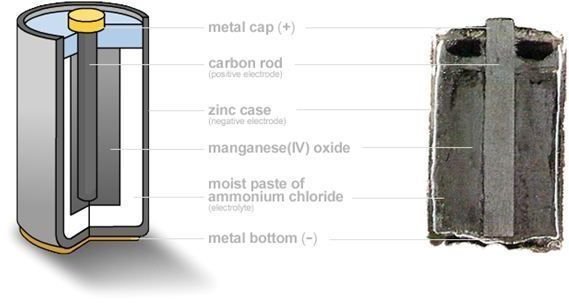
Parts: Anode (Negative Terminal): Zinc Cathode (Positive Terminal):Carbon coated with MnO2 Electrolyte: Mixture of plaster of Paris, Ammonium Chloride and Zinc Chloride
Dry
cells contain a Zinc container which itself acts as a negative
electrode. The moist paste is made from a mixture of plaster of Paris,
Ammonium Chloride, and Zinc Chloride called sal ammoniac paste. This
forms the electrolyte of the cell and takes up the major amount of
volume in the battery. Zinc Chloride is hygroscopic in nature and helps
to maintain the moistness of the paste. It is wrapped in a canvas sheet.
Anode reaction: The oxidization of Zinc gives two electrons.
Zn(solid) → Zn2 + (aqueous) + 2 (e-)
The carbon rod forms the positive electrode. It is coated with MnO2
and powdered carbon. The powdered carbon reduces the internal
resistance of the cell. The top of the cell contains a layer of sawdust.
This acts as the base for the top layer of bitumen used for sealing
purposes.
Zn(s) + 2MnO2(s) + 2NH4(+)(aqueous) → Mn2O3(solid) + Zn(NH3)2 (2+)(aqueous) + H2O(liquid)
A
vent is provided in this layer to allow the gases formed in the
chemical reaction to escape. Irrespective of the size of the dry cell,
the EMF is 1.5 V because the zinc and carbon rods used as electrodes
specified a chemical equivalent. The chemical equivalent changes from
metal to metal and, depending on the type of combination used, the EMF
differs.
Daniell
cell is also known as Galvanic cell which using same working principle
as voltaic cell. It converts chemical energy to electrical energy.
Daniell cell is a part of a battery consisting of two metals joined by a
salt bridge or a porous pot.
More electropositive metal acts as negative terminal which undergoes oxidation process (release electron)
Less electropositive metal acts as positive terminal which undergoes reduction (gain electron).
Electron flow from negative terminal to positive terminal.
The
function of salt bridge or porous pot is to allow the movement of ions
to pass through it to complete electrical circuit. Another function is
to separate two electrolyte solutions.
Examples of salt bridge are sodium chloride or potassium nitrate.
At Negative Terminal: More electropositive metal ( Zinc )
Observation: Zinc plate dissolves or becomes thinner, its mass decreases
Half chemical equation : Zn ------> Zn2+ + 2e
At Positive Terminal: Less electropositive metal ( Copper )
चीनी, नमक और पानी का घोल. किचन
से वास्ता रखने वालों को ये नुस्खा तो शायद कई सौ साल पहले से ही पता होगा,
लेकिन इस घोल में किस अनुपात में क्या हो, यह बताने में डॉक्टर नॉर्बर्ट
हिर्सहॉर्न की अहम भूमिका रही. डॉक्टर नॉर्बर्ट के इस नुस्खे ने लगभग पाँच
करोड़ ज़िंदगियाँ बचाई हैं.
मिस्र में एक तीन महीने का बच्चा दो दिन से
डायरिया का शिकार है इस कदर कमज़ोर हो गया है कि वह दूध पीने के लिए मां के
स्तन पर अपना सिर तक नहीं टिका पाता. अलेक्सांद्र के उपचार केंद्र में जब
इस बच्चे को लाया गया तो एकबारगी डॉक्टर भी घबरा गए थे.
लेकिन उपचार के चार घंटे बाद ही वह मां का दूध पीने लगा और यह सब संभव हुआ चीनी, नमक और पानी के घोल से.
डॉक्टर नॉर्बर्ट का कहना है कि ओरल रिहाइड्रेशन थेरेपी के परिणाम अविश्वसनीय रहे हैं.
संतुलन की प्यास
डॉक्टर नॉर्बर्ट 1964 से ओरल रिहाइड्रेशन थेरेपी से जुड़े. वह अमरीका की सैन्य स्वास्थ्य सेवा में थे.
बांग्लादेश (तब पूर्वी पाकिस्तान) में हैजा गंभीर
रूप ले चुका था. ऐसे वक़्त डॉक्टर नॉर्बर्ट को वहाँ भेजा गया. हैजा होने से
मरीज के शरीर में पानी की भारी कमी हो जाती है और वह कुछ ही घंटों में दम
तोड़ सकता है.
मिस्र में महिलाएं अपने बच्चों को नमक-चीनी का घोल पिलाते हुए
पूर्वी पाकिस्तान के लगभग 40 प्रतिशत गांवों में लोग हैज़े का इलाज न होने से मर रहे थे.
तब रिहाइड्रेशन का उपचार अस्पताल में नस के माध्यम
से होता था. यह महंगा था और उनको नहीं मिल पाता था जिन्हें इसकी सबसे
ज़्यादा ज़रूरत होती थी.
असाधारण नतीजे
इसलिए मुंह के रास्ते दिए जाने वाले उपचार पाने की कोशिशें की गई ताकि अधिक से अधिक लोगों की मदद की जा सके.
नमक, चीनी और पानी के सही अनुपात पर कई प्रयोग पहले भी हो चुके थे, लेकिन ये नाकामयाब रहे थे और कई मरीजों की मौत हुई थी.
डायरिया से पीड़ित इस व्यक्ति को एक हफ्ते में 100 से अधिक ग्लूगोज की बोतलें चढ़ानीं पड़ीं
डॉक्टर नॉर्बर्ट कहते हैं, "ताइवान और फिलीपींस
में नौसेना के साथ तैनाती के दौरान भी मैंने सही नुस्खा बनाने की कोशिश की,
लेकिन यह कुछ ज़्यादा ही गाढ़ा बन गया और चीज़ें और ख़राब हो गईं."
डॉक्टर नॉर्बर्ट ने बताया, "इस नुस्खे का आसान
होना की इसका दुश्मन था. शिशुरोग विशेषज्ञों को यह समझाने में लंबा समय लग
गया कि यह सुरक्षित है."
ब्रिटेन की स्वास्थ्य पत्रिका लांसेट और यूनिसेफ़
ने इसे स्वास्थ्य क्षेत्र में बीसवीं सदी की सबसे उम्दा खोज बताया है,
जिसने बेहद सस्ती होने के बावजूद हर साल लाखों जीवन बचाई है.